
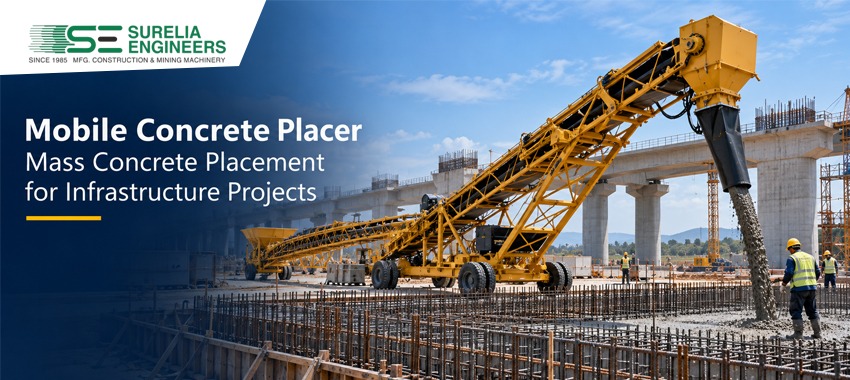
Managing large volume concrete placements Infrastructure project companies use a range of placement equipment when executing large-volume, high-elevation and difficult access placements on project sites. Large dam, canal, bridge, highway and industrial floor projects involve great volumes of concrete that need to be installed as planned at each placement. Selecting the right equipment allows contractors to control the operations on site and coordinate the flow of concrete.
A Mobile Concrete Placer may also accommodate these needs by moving concrete throughout the jobsite via the conveyor. Due to its reach and portability, it can be beneficial for infrastructure jobs, where equipment may need to be moved often or where jobsite access may be limited.
Comprehending the Difficulties of Mass Concrete Placement
Mass concrete placement is the placement of large volumes of concrete within the limits of construction sequencing. The contractor must plan, time and coordinate mixing, delivery, placement, consolidation, and finishing to prevent frequent interruption of work.
On large sites the pour point of location may be quite some distance from the delivery point, and the layout of foundations, retaining walls and general structural configuration may limit the movement of equipment. Lack of coordination can cause delays and disrupt the schedule.
Having the placement schedule defined beforehand allows contractors to know how far they will need to reach, where the equipment will be positioned, what to expect in the way of delivery, and the manpower needed prior to the time they start pouring concrete.
How the Equipment Supports Large-Scale Concrete Placement
A mobile concrete placer spreads concrete throughout the specified work area via a conveyor belt. With some models, it may have the ability to move the material to a distance that would not be feasible with a single setup or without the need for several set-up points.
This allows you to have access for even the largest of foundations, structural runs and large flooring areas. Access can be provided to equipment location ensuring the site teams can manage concrete delivery to fit the placement sequence and avoid unnecessary movement.
But the actual performance will be influenced by the supply of concrete, conditions at the site, the configuration of the equipment and the way in which it is used. Good planning will still be necessary to ensure a smooth process during a big pour.
Infrastructure Projects That Require Efficient Concrete Distribution
Various infrastructure projects have unique placement requirements. It's important to understand your construction environment, in addition to how much space you need to cover.
Dams and anicuts: Areas of large foundation sections, retaining structures and spillway portions necessitate detailed attention to both the distribution of concrete and the sequencing of concrete placement.
Canals and barrages: Larger construction areas require machinery that covers the construction area and flows smoothly.
Bridges and flyovers: foundations, abutments, approach work and other concrete work may need to be positioned in more than one plane due to site constraints.
Highways & airports: Extensive areas of paving and infrastructure that necessitate synchronisation of concrete supply, moving, settlement and finishing.
Industrial floors: Warehouses, manufacturing plants and other large industrial facilities will usually have very large ground areas that require methodical placement of concrete.
Marine structures and precast yards: Equipment selection is affected by constraints on access, layouts for production and the location of casting areas.
For these jobs, the proper tools configuration is determined by the layout, amount of concrete, and accessibility and distance to the placement.
Choosing the Appropriate Reach for the Project
Reach is a factor in choosing a Mobile Concrete Placer for infrastructure projects. Ensure the unit you choose provides adequate reach to place the area you need to in a seamless manner.
These may be more suitable for projects where the placement is medium reach in length such as some of the canal work, retaining structures, precast yards etc. Surelia Engineers are a complete solution provider for medium-reach models with conveyor lengths of 10-20 metre and placing heights of 5-10 metre.
Where many areas require placement, long-reach may be more suitable. Surelia Engineers provide a range of long-reach models – conveyor lengths from 25 to 33 metres, and placing heights from 6 to 15 metres.
The working reach, placing height, site access and type of equipment layout should be checked with the manufacturer before choosing the right contractor.
What factors affect placement performance
The type of equipment used is just one factor that affects how well you can place and finish the concrete. In addition to the equipment, all of the following elements need to come together:
First, the concrete supply has to be scheduled in tandem with the placement rate to avoid delays. When selecting a concrete mix, the delivery requirements and technical specifications for the project need to be taken into account.
Second, Operators require training in how to safely and effectively operate and position the machine. The site access, ground conditions and safe operating dimensions should all be considered prior to the works commencing.
Regular inspections and servicing are just as critical. You should regularly inspect conveyor parts, hydraulics, and other parts as outlined in the manufacturer's specifications to catch any issues before they cause delays.
Why Equipment Selection Matters for Project Planning
Choosing the right equipment pack at this stage means contractors can better coordinate labour, use of materials, access to the site and delivery of concrete. Having an optimal combination of equipment can also cut down on the number of relocations needed.
Prior to purchase, a contractor should: anticipate the volume of concrete that will be needed, look at how far the concrete must be placed and the lift height needed, compare the needs of the job to the conditions under which it will be done, and determine if maintenance and spare-parts support is available.
Mobile Concrete Placer needs to meet the true demand of the project. For this reason, applications shouldn't choose a Mobile Concrete Placer available performance but rather one which addresses the actual project workload.
How to Plan Effective Placement of Concrete for Infrastructure Projects
The construction of infrastructure requires the compatibility of equipment capabilities with site conditions. The contractors shall plan the placement sequence, facilitate communication between the concrete suppliers and site team, and follow documented safety procedures by operators.
In case of long concrete distribution projects, check out the medium-reach and long-reach boom options to select the right model. Surelia Engineers provides the right machine for various needs such as dams, bridges, canals, precast yards, and infrastructure projects.
Final Recommendations for Infrastructure Contractors
High concrete pours require careful planning, as there is not just enough material to pour. Contractors also need to think about the placement distance, working height, site access, concrete flowability, equipment calibration and productivity, and construction crew interaction.
For some contractors, a Mobile Concrete Placer can be a manageable piece of equipment that can help spread concrete over a larger amount of working space. Before making your decision, consider space as well as details about the specs of the equipment and the site.
Browse Mobile Concrete Placer Models from Surelia Engineers for a new infrastructure project.