
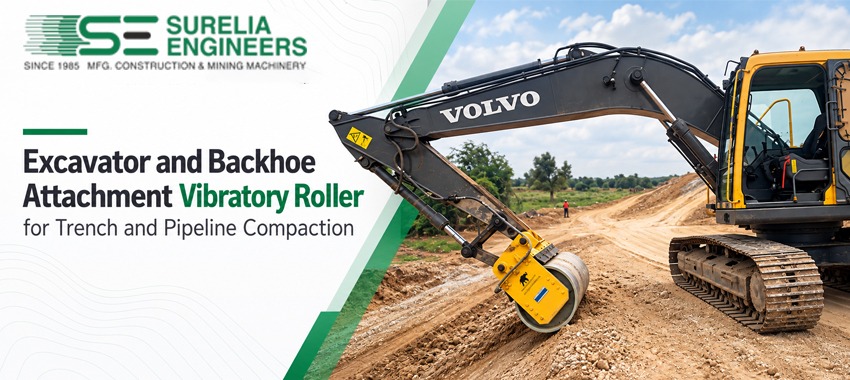
These projects involve trench support and ground preparation to facilitate the installation of buried services and to retain the soils around the trench. Water supply and drain lines, drain fields, irrigation lines, and underground service installation frequently have small working areas, making it challenging for conventional compaction equipment to get to the job. An Excavator & Backhoe Attachment Vibratory Roller is an option to consider when a carrier machine can place the roller where needed.
Why You Need to Plan for Trench Compaction
The compaction of soil adjacent to a pipeline is not just brute forcing the material down. Contractors must adhere to the approved backfilling procedure and have the right product for the pipe and existing ground conditions. Width and depth of the trench, proximity to existing infrastructure, groundwater, and the type of utility installed all contribute to the backfill method used.
Backfill is often placed in a series of approved lifts that will allow the backfill to be properly compressed. Too much pressure and machinery near the pipe will damage it and not enough compaction can lead to settlement down the road. Prior to work, the site team should analyze drawings, underground utilities, soils, and the project's compaction standards.
Supporting Pipeline Backfilling Projects
An Excavator & Backhoe Attachment Vibratory Roller could possibly be advantageous for appropriate segments of water supply, drainage, irrigation and different utility schemes. As a result of it attaching to a service equipment, the roller could be reached by an excavator or backhoe, relatively than requiring a separate compaction equipment in every case. This can be helpful if entry routes and site layouts make positioning gear a vital consideration.
But, attachment cannot be fitted to all pipeline trench automatically. Contractors need to check if the size, work-force and working mode of it would be fit for pipe material, trench form, backfill condition and compaction method. Once in close proximity to pipe, bedding and compaction method stipulated should override work speed or facility.
How the Attachment on Site Works
An Excavator & Backhoe Attachment Vibratory Roller compacts any type of soil with a roller drum and vibration when used in accordance with the manufacturer's operating instructions. The carrier machine places the attachment over the correct area of operation, enabling the operator to roll along properly prepared lengths of trench or backfill.
Operational procedures will vary with the type of attachment and the conditions on site. The operator will have to keep the equipment stable, adhere to the guidance on the operation, and steer clear of hitting any underground utility services or the pipeline after its installation. The team should manage compaction along with backfilling at all times to achieve the best possible result.
Selecting the Proper Attachment for Trenching Work
Prior to choosing an Excavator & Backhoe Attachment Vibratory Roller, contractors must verify its suitability for your own backhoe or excavator. Some of the factors to consider are Carrier capacity, hydraulic flow and pressure requirements, Mounting arrangement, Drum width, working depth of trench etc. These specifications should be compared with the latest specifications of the manufacturer.
Drum width becomes significant when there is limited space. If the drum is too wide to manoeuvre in a narrow trench, it may be difficult or impossible to locate in a suitable area for compaction, and an inappropriate configuration could prevent access to the area of intended compaction. The positioning of the carrier may also be constrained.
Choose based on how it will be used, not on the belief that one attachment will always be suitable for every site. Talk about trench size, soil conditions, your operating environment and the model of machine you will be using with your supplier before settling on a configuration.
Factors That Affect Compaction Quality
An Excavator & Backhoe Attachment Vibratory Roller is just one step in the compaction process. Soil type, moisture, backfill material, the thickness of the layer being filled, and the method of operation can all affect the outcome. Too moist or too dry materials may not compact correctly, and various soil types may require varied methods.
Contractors are to backfill according to the project specifications, pay attention to layer thickness, and have compaction done by a competent individual with the correct method as necessary. Several passes does not always equate to proper density. Good material, placement, sub-grade, preparation, and verification are factors in achieving desired results.
Safety and Operation Considerations
Determine if underground services are present, and that it is safe to commence the backfilling stage for which pipe installation has been scheduled. Follow the site safety plan and specified trench-safety guideline. Ensure that operators keep personnel away from the attachment operating area and maintain a safe distance away from the machine and away from unsupported, unshored trenches.
For the attachment and carrier machine, operate it according to the instructions, Inspect the attachment and carrier machine before use, and cease operations if damage or unsafe ground conditions are detected. Never operate above the rated capacity of the attachment, or the limits of the carrier machine.
When To Consider This Equipment
An Excavator & Backhoe Attachment Vibratory Roller is certainly something that should be considered when a project involves a compatible carrier machine and controlled compaction on appropriate backfill or trench zones. It may also be something to consider if layout considerations are at the forefront.
The method must also be considered for technical fit, pipe protection, soil condition, and the contractor's compaction plan. If a wide area or delicate segment is involved, an alternative technique may be required. Discuss the work sequence with the project engineer and equipment supplier to ensure the approach meets project specs and protects both pipeline and crew.
Conclusion
Backfilling, pipeline backfilling and general trench work are only as reliable as the backfill used, the way the backfill is installed, the safety precautions taken in the application and ascertained to meet specifications. When used in the right scenarios, An Excavator & Backhoe Attachment Vibratory Roller may be used, but determine compatibility between trench size and carriage, as well as soil type.
For utility or infrastructure work projects, contractors can learn about the vibratory roller attachment for excavators and backhoes and check for latest specifications through Surelia Engineer.